




COTY Reviews: Kokoda Caravans XG1 C216
Cool Operator
Words COTY judges, Pics Allison Watt, Josh Hanger, John Ford
Kokoda Caravans has made a name for itself with its bold, often industry-defying designs, and the new XG1 C216 continues that trend with a thoughtfully executed and impressively airtight couples van designed for extended travel. While there might not be a flaming loo this year, it still carries the hallmarks of a Kokoda: considered design and genuine innovation.
Kokoda returned to COTY this year with a very clear point to prove. In 2025, Trevor Price and his team came agonisingly close to winning with the Counterstrike Vincere — a full-blown technological behemoth that pushed the boundaries of what a caravan could be. It was impressive, no doubt, but also a reminder that more isn’t always what buyers are chasing.
This year’s entrant, the XG1 C216, feels like a far more considered response. It hasn’t lost the hallmarks of a top-end Kokoda — the insulation, the split-system air-conditioning and a properly sorted off-grid platform are all still included — but the focus has shifted. There’s a greater emphasis on usable space, practical storage and payload, as well as a move back toward systems and layouts that reflect how people actually travel.
The result is a caravan that still turns heads, but for different reasons. It’s not trying to overwhelm with complexity; instead, it delivers a refined, confident take on what pinnacle caravanning looks like today. That measured approach paid off, with Kokoda earning a well-deserved result and reinforcing just how well Trevor and the Kokoda team understand their market.

Customer care
At this end of the market, customer care is less about promises and more about how confidently a brand backs its product in the real world. Kokoda’s approach is fairly straightforward: a three-year warranty across the van, with structural elements handled in-house and major components supported by their original manufacturers. The TerraGlide suspension system also carries a three-year warranty, with no kilometre limitation, which aligns neatly with how the van is intended to be used.
What stands out is the philosophy behind it. There’s a clear sense of what you might call a ‘no-dickhead policy’ — use the van as intended, tow it properly and look after it, and you’re covered. Push beyond that, and the responsibility shifts back to the owner. It’s a realistic position for a serious offroad van, but one that relies on buyers' understanding where that line sits.
The use of proven components like Victron electrical systems and Thetford appliances adds confidence, even though those fall under separate warranties. Still, at this level, a three-year term feels a little light. It’s not out of step with parts of the market but extending that coverage to five years would better match the expectation — and price point — of a van like this.
Self-sufficiency
The Kokoda XG1’s electrical system is best understood when you step away from 12V figures and look at what it delivers in real terms. Twin Baintech 460Ah lithium LiFePO4 batteries equate to roughly 11kWh nominal, with about 9kWh usable, backed by quality prismatic-cell construction and a properly integrated Victron system. At the centre of it is a 5000W Victron inverter/charger, which means you’re not just running a van — you’re comfortably powering multiple 240V outlets at once without ever feeling close to the ceiling.
In practice, this is a system that’s built for how people actually travel. The LG 5kW domestic split-system air-conditioner will typically settle into a 700–1000W draw and most owners will only run it for three to four hours to pull the heat out of the day. That’s roughly 3kWh easily supported by a 1720W solar array capable of returning 5–7kWh on a good day. Even with induction cooking — short bursts at high draw — the system remains comfortably within its limits.
What elevates it further is the insulation. With no roof vents and a thick composite structure, the van holds its temperature exceptionally well, reducing demand on the air conditioner and stretching that energy even further.
Kokoda has also made a deliberate call to keep a traditional cassette toilet. Trevor’s view is simple — use biodegradable additives and dispose of waste responsibly, including burial where appropriate, rather than relying on more complex systems. It’s a practical, user-focused choice.
In reality, power isn’t the limiter here — water is. With 330L onboard, you’re looking at around 10–11 days, and with a bit of care you can get that closer to two weeks. To say the XG1 C216 has off-grid life sorted is an understatement.

X-factor
The Kokoda XG1 C216’s X-factor is immediate and unmistakable — this is a van that visually dominates. It stands tall at 3.35m (11ft) and, with its distinctive rear profile housing the split-system air-conditioner, breaks away from the sea of conventional, boxy caravans. The colour palette only adds to that presence, giving it a sharp, premium look that feels deliberate rather than over-styled.
Step inside and that sense of difference continues. The use of captain’s chairs won’t be for everyone, but it reinforces that this isn’t a van chasing tradition for the sake of it. The ensuite, meanwhile, is a genuine standout — the kind of space that makes you stop and take notice.
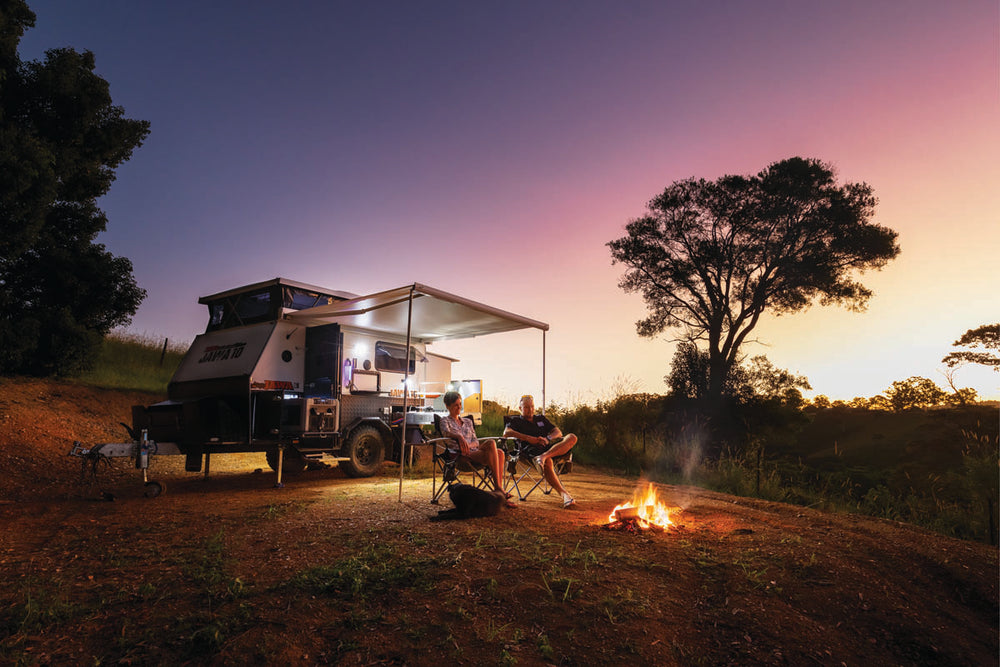
Beyond the visual impact, there’s substance to back it up. The fully flat floor, strong off-grid capability and a clear focus on insulation and thermal performance all contribute to a van that feels considered and complete. Around the campfire, the story here isn’t about compromise — it’s about presence, and Kokoda delivers that in a big way.
Build quality
Over the last seven years, Trevor and Kathryn Price have turned Kokoda Caravans into a powerhouse of innovation and superior construction. Every new model has been a step forward, and the attention to detail is among the best. The Price family travels extensively whenever they get the chance to test the product’s durability, reliability and ease of use. Lessons learned translate into improvements in build and design, as evidenced by the evolving range. They aren’t afraid to think big, and the XG1 C216 at this year’s event is an oversize couples van with high-level engineering.
Tare weight is 3100kg and payload is around 1390kg, so it’s a pretty substantial van. Supporting the weight and engineered for outback travel is a hefty galvanised and painted steel chassis with TerraGlide semi trailing arm suspension. This airbag system has onboard and phone app controls, as well as automatic horizon levelling.
Kokoda has adopted bonded sandwich panel composite construction, emphasising thermal efficiency and strength. The roof, walls and floor are chemically fused into a single unit that’s immensely strong and resistant to vibration and shock over rough terrain. The gas-free caravan body is sealed from dust, while thicker-than-usual walls and roof are designed without internal wiring to reduce heat transfer and maximise insulation. The roof is a twin layer of composite, for a massive 80mm of insulation where it's needed most and the floor is 40mm. In addition to the effective insulation, all hatches are insulated and there are no roof openings to allow heat to transfer.
Internal joinery is built from lightweight materials and features a high degree of fit and finish.
Kokoda has around 1000 quality control checkpoints throughout the build and a large-volume water test at the end of production to ensure the vans are leak-proof.

Liveability and Ease of Use
The reclining lounges in the spacious interior won me over when I stepped inside. They are big enough to be supremely comfortable yet still allow easy access through to the ensuite at the back. And as much as I’m not usually a big fan of oversized bathrooms, the practical storage options, including the full-height wardrobe, make sense for a van dedicated to long-term travel. Lots of space in the ensuite will suit larger bodies and those of us keen on makeup and hair fashion.
Bed access is as good as you get, with a north-south arrangement and wide walkways on each side. There are also thoughtful storage options, including a shoe locker that doubles as a step and nooks at each side of the bed for personal items.
Travellers to northern climates will appreciate the superior insulation of the composite body, but there’s a diesel heater if a snowy landscape takes your fancy. Ducted air-conditioning covers extreme weather, and the silent running of the isolated split system will be welcome.
Storage throughout the van, including in the front garage, combined with the hefty payload means long-term travellers can bring all the toys and any extra equipment they like without risking overloading. Another practical idea and a great use of space is the outdoor washing machine with a handy laundry chute from the ensuite next to it.
A lot of thought has gone into devising an off-grid electrical system to power all the appliances without worrying about whether there’s enough battery power. With a 5000W inverter, you can even use the cooking appliances and the air-conditioner at the same time. Three 110L freshwater tanks give a generous supply for a couple and the removable 40L grey water tank is a smart solution for those camps that require one.
Innovation
So much thought has gone into the Kokoda XG1 C216; it bristles with innovative features and design choices. Keeping the van well-insulated was a high priority and spurred on by Trevor’s drive to reduce energy demand rather than increase power. The hot Australian sun beats down on the roof of a van, so Kokoda has put the thickest insulation where it’s needed and avoids compromising heat dissipation with openings.
And without openings in the roof, the area can be covered with solar panels — in this case, lightweight, high-quality, flexible, flat panels that save weight. There’s also more weight saving in the build: 80kg by employing C-sections and removing unnecessary structure in the chassis, and 150kg by using lightweight composites in the joinery.
If the temperature can be controlled naturally, the need for more power to run a cooling system will be less. That’s not to suggest the power supply is compromised because 1720W of solar and 920Ah of battery is significant. Moving back to 12V power from 48V systems is also a smart decision because it’s more reliable and easier to repair in remote locations by an auto electrician. The move to 48V offered efficiencies of installation — smaller wire gauge, for example — and for large power draws, but it also created complications with the need for step-down power for appliances and DC/DC charging.
The Kokoda’s installation also eschews the trend of placing power installations behind the 274L fridge, where they create a thermal weak point. A fridge makes heat to cool, and that’s the last thing an electrical system needs to operate properly. Kokoda has the installation under the furniture, where it gets ample ventilation and uses some of the less-accessible space.
A word on the electrical installation. The system is designed to keep wiring runs as short as possible for maximum efficiency and uses the thickest main wires I have seen in a caravan to minimise voltage loss and increase safety.
There’s a final feature that will be a back saver to anyone with the misfortune of a flat tyre: the winch point above the spare. It’s bad enough changing a heavy caravan tyre, let alone lifting the filthy, damaged one back into place, so you might be grateful for this inclusion on a dark night out on the track.

Value for money
The purchase price of the Kokoda XG1 C216 is $230,000, which puts it out of reach for many folks. In a cost-of-living crisis and where there is uncertainty around fuel, opinions about price can be divided, if some of the comments on our Facebook page were any indication.
But the value for money category is not just about the initial outlay for purchasing a van. In simple terms, value for money is about whether something is worth what has been spent on it — what value does the customer derive from the product in return for the money spent on it?
In his very comprehensive response to the judging criteria, owner Trevor said true value is measured by the cost to achieve an outcome, not the cost of the components fitted.
The XG range (X stands for composite build, G stands for garage) replaces the Counterstrike at the top of Kokoda’s extensive range. The C216 (couples, 21ft 6in) is just one of hundreds of layouts available across the range.
As it stands, this van doesn’t need any upgrades or added options. Trevor has made a deliberate choice to include, as standard, higher-grade suspension, lightweight cabinetry, insulation integrity, split-system air-conditioning, insulated external hatch doors, and Raptor coating.
Towability
The Kokoda XG1 C216 is a big van and has an ATM of 4490kg, so it needs a big American truck such as Trevor’s Chevrolet Silverado 2500HD to haul it around. All of a sudden, this combination becomes a half million-dollar rig.
However, the tare is 3100kg. Fully loaded with 650kg of water and gear, it comes in at around 3750kg for towing. Even then, there’s still plenty of the 1390kg payload to spare.
The construction of the Kokoda XG1 C216 contributes greatly to its towability. There is nothing on the roof to drag — no protruding air-conditioning unit, no hatches, no antennas — nothing. Its XPS foam sandwich panels and fibreglass cladding make it lightweight but rigid. Smaller electrical systems have reduced weight. The design and layout are balanced.
The TerraGlide TG-X-1 airbag suspension with 230mm of travel also helps maintain a consistent ride height and stability.
Suitability for intended touring
The Kokoda XG1 C216 will go almost anywhere. It is built for harsh conditions and corrugated roads, and its off-grid systems are designed for sustained, not just occasional, use.
Trevor is passionate about his product and is constantly travelling with his family to put his vans through hundreds of hours of real-world testing, pushing them to their limits to make sure they’ll stand up to the rigours of remote adventure travel. He identifies where improvements can be made, comes home, tweaks and refines the design and the build. He rarely rests.
A huge amount of effort and research has gone into the thermal properties and energy performance of the XG1 C216 with a focus on reducing the demand for energy instead of the increasing the supply.
With its composite construction, the XG1 C216 is like a giant Esky — meaning it will stay warm in winter and cool in summer. Trevor identified and removed the weak spots where heat can enter, such as the roof hatches, vents, uninsulated doors, framing and wiring channels. Poor layout and undersized wiring in electrical systems result in them generating their own heat. That means that owners are forced to run their air-conditioners for longer periods, thereby quickly depleting their solar and battery systems. All these issues were addressed — reducing the amount of heat entering the van and systems which generate heat at the source, such as locating the electrics in cooler zones.
Trevor has so much confidence in the airtightness of this van he hasn’t included a dust reduction system. With no vents and hatches there’s literally nowhere for dust to get in.
All up, the Kokoda XG1 C216 was a truly impressive entrant at this year’s COTY, reflecting Kokoda’s continued drive for innovation alongside a clear understanding of how people travel and what’s needed to support extended time on the road.
KOKODA CARAVANS XG1 C216
WEIGHTS AND MEASURES
Overall length 9.4m (30ft 9in)
External body length 7.35m (24ft 1in)
Internal body length 6.6m (21ft 7in)
Width 2.48m (8ft 2in)
Travel height 3.35m (11ft)
Internal height 2m (6ft 6in)
Tare 3100kg
ATM 4490kg
Payload 1390kg (calculated)
Ball weight at tare 280kg
Ball to tare ratio 9% (calculated)
EXTERNAL
Frame Composite Xcore XPS foam sandwich panel
Cladding Fibreglass
Chassis Galvanised and painted 200mm Australian steel
Suspension TerraGlide TG-X-1 semi trailing arm airbag
Coupling Cruisemaster DO45
Brakes 12in electric drums
Wheels 16in alloy MT tyres
Water 3 x 110L freshwater, 1 x 40L grey water (portable)
Battery 2 x 460Ah Baintech lithium LiFePO4
Inverter 5000W Victron
Solar 1720W
Air-conditioner LG 5kW split system
Gas 2 x 4kg (for barbeque)
Sway control Optional, the van is designed not to need ESC
Washing machine RV Ecowash 3kg
INTERNAL
Cooking Portable induction cooktop
Microwave Plateless microwave
Fridge 274L Thetford compressor
Bathroom Full-width ensuite with separate shower, cassette toilet and laundry chute to external washing machine
Hot water Swift gas, electric
PRICE FROM $226,000
OPTIONS FITTED GVM upgrade, Thule bike rack
PRICE AS SHOWN $230,100
MORE INFORMATION
Kokoda Caravans - https://www.kokodacaravans.com.au/
Counterstrike Vincere - https://www.kokodacaravans.com.au/vincere
XG1 C216 - https://www.kokodacaravans.com.au/caravan-of-the-year
Kokoda XG1 - https://www.kokodacaravans.com.au/xg-range
customer care - https://www.kokodacaravans.com.au/owning-a-kokoda
composite construction - https://www.kokodacaravans.com.au/xcore-construction
Kokoda Caravans
1600 Sydney Road
Campbellfield Vic 3061
P: 1800 577 430
E: enquiries@kokodacaravans.com.au


Whether you're planning a weekend getaway or a long-haul adventure, having the right resources can make all the difference when you're out of range. To help you navigate with confidence, you might find it useful to pair your journey with a detailed set of topographical road maps or a comprehensive campsite guide. Explore some of the maps below or visit our store for a full range of products.


COTY Reviews: Kokoda Caravans XG1 C216