



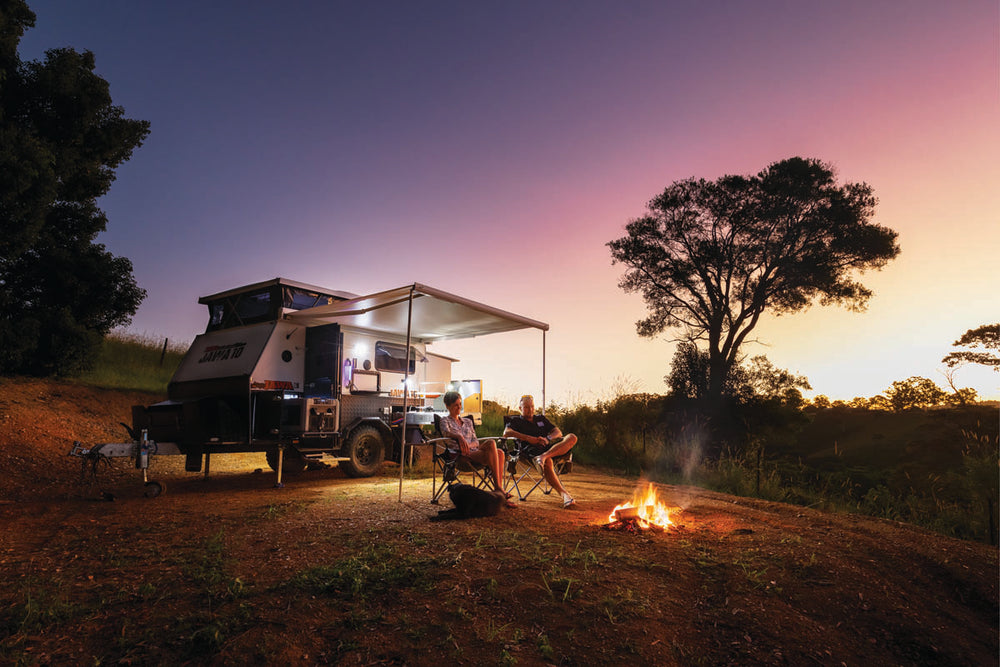

Stockman Trekka
The hybrid caravan market has matured. Today's premium hybrids need to be easy to tow, simple to set up and genuinely capable of extended off-grid touring, while reflecting the way their owners live. Storage for expensive adventure gear, quality materials and genuine comfort are now expected rather than optional. The Stockman Trekka is one of the best to answer that brief.
Where Does It Fit?
Stockman isn't a newcomer chasing the booming hybrid caravan market. Celebrating two decades in business, the company has built its reputation gradually, with just three model families introduced during that time. It began with the Pod, a lightweight off-road camper that has now found more than 5,000 owners, before expanding into the larger Rover, with more than 1,000 now on Australian roads. Rather than constantly reinventing itself, Stockman has tended to evolve its products slowly, learning from customers before committing to something genuinely new.
The Trekka represents the next step in that evolution. The Trekka arrives in Australia as a largely assembled product before final plumbing, compliance, fit-out and Australian-spec Cruisemaster suspension are completed at Stockman's Melbourne headquarters. It's a manufacturing model that allows Stockman to focus its engineering and quality control where it matters most, while delivering a level of finish that's competitive with the segment's best.
Sitting above the Pod and Rover as the company's premium hybrid, it's aimed at buyers wanting genuine off-grid capability without sacrificing the comfort and refinement of a modern caravan. Offered in On-Road, Ultra XT and flagship Platinum XT variants, pricing starts from $114,990, with our well-equipped Ultra XT test van checking in at $133,528.
What you see here was equipped with Stockman's flagship off-grid package, self-levelling Cruisemaster XT air suspension with Body Control System, Webasto off-grid air-conditioning and a range of touring accessories, resulting in a 2,604kg tare weight and 3,400kg ATM.


Suitability for Intended Touring
The Trekka is unapologetically a couples' tourer. There are no bunks or family-friendly compromises here. Instead, it's aimed squarely at buyers who measure a trip by what they can do once they arrive, not simply where they camp.
Unlike many premium hybrids, the Trekka asks a different question: what do you want to take with you? Whether it's a pair of expensive e-mountain bikes, an inflatable boat and outboard or a trail bike, the enormous front storage has been designed around securely carrying the equipment that defines your adventure, not just your accommodation.
The Trekka isn't trying to be everything to everyone. It's built for travellers who see the caravan as the means to an adventure, rather than the adventure itself.
The Competition
The good news for buyers is that this corner of the market has never been stronger. Around the Trekka sits a collection of genuinely capable Australian-built hybrids, each approaching the same brief from a slightly different direction.
Cub's H16 is one of the benchmark lightweight hybrids. Beautifully built and Australian-made, a realistically optioned example lands around the $130,000 mark and appeals to buyers who value low weight and refined simplicity. The Lifestyle Reconn occupies a similar price bracket, pairing an alcove kitchen and pop-top layout with a more utilitarian approach that has stood the test of time, although its relatively modest front storage can't match the Trekka's adventure-focused nosecone.
Step further up the price ladder, and the philosophies diverge again. An Offline Solitaire 16, realistically optioned, pushes towards $160,000, trading additional canvas and setup for exceptional internal living space. Beyond that sits Patriot's ST5 at around $170,000, an engineering-led Australian-built hybrid that has become something of the benchmark for buyers chasing outright off-road capability.
What makes the Trekka interesting is that it isn't trying to beat any of them at their own game. Instead, Stockman has built a hybrid around a different lifestyle. The emphasis isn't simply on where you can travel, but on what you can securely take with you once you get there. The Trekka's enormous nosecone and contemporary design philosophy create a niche that none of its rivals quite approaches in the same way.
Design Philosophy & Build
The Trekka's defining feature is impossible to miss. That enormous moulded fibreglass nosecone dominates the front of the van, but unlike many styling exercises, it exists for a very practical reason. Stockman wanted a secure, weatherproof space capable of carrying the sort of equipment that active travellers increasingly refuse to leave behind. Depending on how it's configured, the compartment can house two e-bikes on dedicated fork or wheel mounts, shelving systems, an inflatable Takacat and outboard, or even a full-sized motocross bike. Integrated 240V and 12V power means e-bikes can be charged on the road or at camp, turning the nosecone into far more than a storage locker. It's really a payload management system, designed around carrying large, awkward and expensive equipment safely and out of the weather.
The same thinking extends to the rear of the Trekka. A heavy-duty rear bar can be configured with a 50mm receiver, jerry can holders, a firewood basket or small storage box depending on the owner's needs. Our test van carried twin jerry can holders, reinforcing the idea that the Trekka is designed to adapt to different touring styles rather than forcing owners into a single solution.
That thinking continues throughout the rest of the Trekka. Rather than dedicating valuable floor space to a large internal kitchen, Stockman has built a generous alcove kitchen into the nearside of the van. A 2000W induction cooktop, sink, 30-litre drawer fridge and practical storage handle day-to-day cooking outside, while a separate 130-litre Bushman upright fridge inside takes care of longer-term food storage. It's a layout that deliberately encourages owners to live outdoors while still delivering the convenience expected from a premium hybrid.
The construction follows the same contemporary philosophy. The body uses insulated composite panels with aluminium outer skins, paired with a welded aluminium roof and an insulated double-skinned pop-top to improve thermal performance. Beneath sits a 150 x 50 x 3.75mm hot-dip galvanised chassis, while our Ultra XT test van added Australian-fitted Cruisemaster XT suspension with self-levelling airbags and Body Control System. It is a specification that reflects where the premium hybrid market now sits: proven running gear, modern materials and practical engineering rather than unnecessary complexity.
The compromise, of course, is physics. A large storage compartment mounted ahead of the axle inevitably influences towball download. Stockman advises that around 55 per cent of whatever is loaded into the nosecone is transferred directly onto the towball, meaning 100kg of bikes and gear can add roughly 55kg to ball weight. In our test configuration—two e-bikes, recovery gear and camping equipment—the Trekka remained well balanced, but it reinforces an important point: the nosecone isn't just about how much you can carry, but how intelligently you load it. That makes payload management just as important as payload capacity, particularly for buyers intending to make full use of one of the Trekka's biggest advantages.
Which naturally raises the next question: what's it actually like to tow?


Towability
With a 3400kg ATM, the Trekka sits at the heavier end of the premium hybrid market, making tow vehicle choice important. We paired it with Ram's MY26 Express Black Edition, which proved an excellent match. More importantly, the Trekka itself was remarkably uneventful to tow.
Our test route ran from Stockman's Carrum Downs headquarters to Tonimbuk, combining metropolitan freeways with fast regional roads and long sweeping climbs. Over the route, the Ram averaged around 17L/100km while towing, dropping to approximately 9L/100km when unhitched on open-road running. Given the conditions and the size of the combination, both figures were impressive.
The optional Cruisemaster Body Control System deserves much of the credit. Hitch up, retract the stabiliser legs and a single button returns the suspension to its preset ride height before you pull away. On the highway, the Trekka tracked straight, felt composed and never demanded correction. A supplied wireless reversing camera also makes manoeuvring and monitoring traffic behind far less stressful.
While the Ram suited it perfectly, buyers don't necessarily need an American Truck. A well-specified dual-cab ute with a 3500kg tow rating, or a large ladder-frame SUV such as a LandCruiser or Patrol, will comfortably tow the Trekka when loaded appropriately.
So, once you've found the perfect campsite, does the Trekka deliver on the promise it makes from the outside?
Liveability
Step inside the Trekka and it's immediately obvious that Stockman has resisted the temptation to chase internal volume at all costs. With an internal body measuring little more than 12 feet, every centimetre has been carefully allocated to create a space that feels contemporary, practical and comfortable.
The front ensuite uses a shower-over-cassette toilet layout familiar to experienced hybrid owners, while both the toilet and 130-litre Bushman fridge remain accessible without raising the electric pop-top—a genuine convenience for roadside stops. Raise the roof and around two metres of headroom, generous natural light and excellent ventilation make the compact interior feel surprisingly spacious.
The full-size domestic queen bed is another welcome decision, supported by a padded headboard, practical shelving, abundant charging points and easy access to the Truma Combi D controls. I'd personally opt for a better-quality mattress, but that's an easy conversation to have at purchase.
The internal kitchenette is deliberately compact, providing everything needed to boil a kettle, prepare breakfast or reheat a meal when the weather turns. Most owners, however, will spend their time cooking in the excellent external alcove kitchen, exactly as Stockman intended.
There are compromises. Internal wardrobe and drawer space are modest, with many owners likely to live from soft bags rather than cupboards. It's a conscious trade-off that reflects the Trekka's priorities: less emphasis on storing clothes, more on carrying the equipment that gets you outdoors.


Self Sufficiency
The Ultra XT tested here was specified with Stockman's flagship off-grid package, centred around a 600Ah Renogy lithium battery bank, 3000W inverter, 80A AC charger, 50A DC-DC charger, 600W of rooftop solar and a 220W portable blanket.
That capacity comfortably supports the Trekka's lifestyle. The Webasto off-grid air-conditioner draws around 700-1000W while operating, but used sensibly, the combination of battery capacity and solar input should comfortably sustain it. Heating and hot water are handled by the excellent Truma Combi D diesel system, which sips fuel while taking pressure off the electrical system.
In reality, power probably won't be what sends you back to civilisation. With 200 litres of fresh water, 120 litres of grey water and a cassette toilet, a couple should comfortably expect four to six days away from services before food, water or waste become the limiting factor. Pack a second cassette and you'll probably be looking for somewhere to refill the water tanks before you're worrying about the toilet.
Taking your new Stockman Trekka off the beaten track? Uneven ground doesn’t have to mean an uneven setup. TRED Outdoors has the levelling solutions you need to get your Trekka level, stable and ready for a comfortable stay - wherever the journey takes you.
Customer Care
Stockman backs the Trekka with a five-year structural warranty covering the chassis, frame and body structure, alongside a two-year general warranty on workmanship and Stockman-installed components. Major suppliers, including Bushman, Truma, Renogy, Cruisemaster and Webasto, provide their own warranties, while the remaining Stockman warranty can be transferred to subsequent owners.
More importantly, the warranty reads like it has been written by people who understand how these trailers are actually used. The Trekka Ultra XT is explicitly warranted for touring, unsealed roads and moderate off-road travel, with sensible servicing requirements and realistic expectations around abuse, overloading and neglect.
After spending time with Phil Savory, Stockman's owner, my impression is that Stockman's greatest strength is that it's still close to its products. Customer feedback genuinely feels like it influences future development, and in an industry that has seen its fair share of uncertainty, that's quietly reassuring.
The Wrap
The Trekka isn't the perfect hybrid. Internal storage is modest, the shower-over-toilet layout won't suit everyone and, at 3400kg ATM, it deserves a capable tow vehicle. But every one of those compromises has been made deliberately.
Rather than chasing the biggest interior or the longest feature list, Stockman has built a hybrid around the way adventurous couples actually travel. The enormous nosecone, thoughtful packaging and contemporary design create a trailer that encourages you to bring your passions along for the journey, not leave them at home.
What impressed me most wasn't any single feature, but the consistency of the design. Every decision feels connected to the next, creating a product that knows exactly what it wants to be.
Would I buy one? Absolutely.
Not because it's the cheapest or the biggest, but because it offers something genuinely different. In a crowded market where many hybrids chase the same formula, the Trekka confidently carves its own path—and it's all the better for it.
STOCKMAN TREKKA ULTRA XT
WEIGHTS AND MEASURES
Overall length 6.50m (21ft 4in)
Internal Body length 3.66m (12ft 0in)
Width 2.25m (7ft 5in)
Travel height 2.7m (8ft 10in) (with optional AC)
Tare kg2,604
ATM 3,400kg
Payload 796kg (calculated)
Ball weight at tare 177kg
Ball to tare ratio 6.8% (calculated)
EXTERNAL
Frame: N/A (monocoque/composite body construction)
Cladding: 33mm Composite insulated panel
Chassis dimensions and construction: 150 x 50 x 3.75mm hot-dip galvanised steel chassis
Suspension Type: Cruisemaster XT independent suspension with optional self-levelling airbags and Body Control System (BCS)
Coupling Type: Cruisemaster DO35
Brakes size and type: 12in electric drum brakes
Wheels size and type: 17 x 9 alloy wheels with 265/65 R17 tyres (1400kg load rating)
Water: 200L fresh / 120L grey
Battery: 600Ah Renogy lithium (optional package fitted to test van)
Inverter: 3000W Renogy pure sine wave
Solar: 2 x 300W roof-mounted panels (600W total), plus 220W portable blanket on test vehicle
Air-conditioner: Webasto Cool Top off-grid air-conditioner
Gas: 2 x 4kg bottle
Sway control: Cruisemaster Body Control System (BCS) electronic stability/tow control with self-levelling air suspension (Ultra XT option)
INTERNAL
Cooking Stove and Oven type: Fixed 2000W induction cooktop (no oven)
Fridge Capacity and Type: 130L Bushman upright compressor fridge/freezer, plus 30L Dometic drawer fridge in external kitchen
Bathroom Layout and design: Front combination shower/cassette toilet (wet bathroom)
Hot water Brand and type: Truma Combi D diesel hot water and space heater
PRICE FROM $114,990
OPTIONS FITTED
Cruisemaster XT self-levelling air suspension with Body Control System (BCS)
600Ah Renogy lithium battery upgrade
3000W Renogy inverter
600W roof-mounted solar
220W portable solar blanket
Prototype rear receiver hitch
Bike storage system (test vehicle)
Webasto Cool Top off-grid air-conditioner
Electric awning
PRICE AS SHOWN $133,528
MORE INFORMATION
Stockman Products
4 Silkwood Rise
Carrum Downs VIC 3201
Australia
P: 1300 725 712
W:stockmanproducts


Stockman Trekka Review: Built Around Adventure