



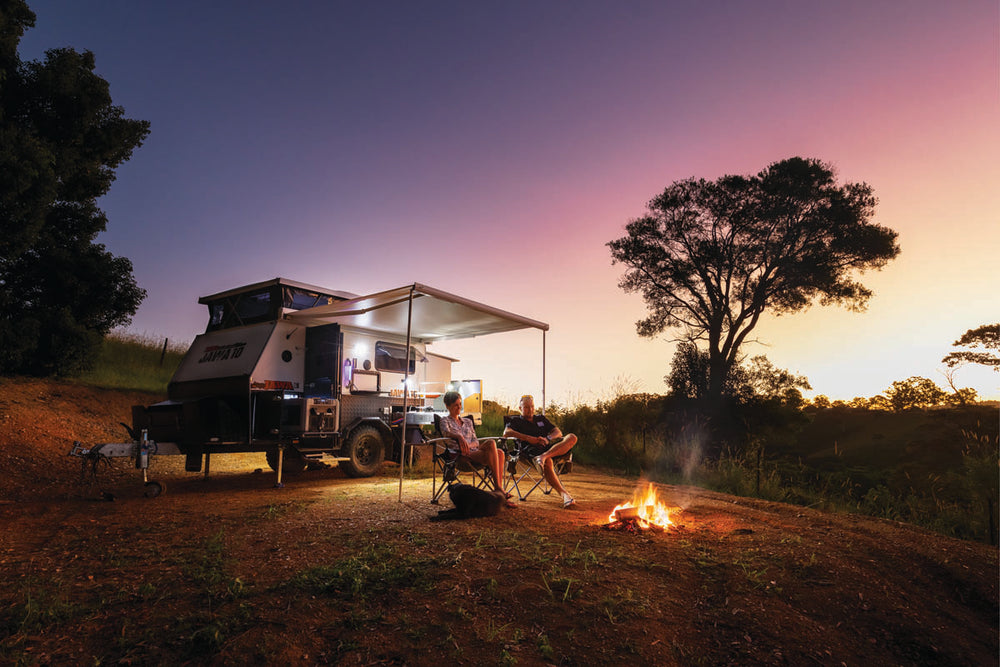

Eden Caravans: 17' Wildtrax
This compact van is offroad capable and has all the right elements for a couple who want to find tracks to wild places.
Among the most consistent comments in our letters to the editor are requests for reviews of smaller caravans, and while I have to admit we usually review larger models, I'm a fan of compact versions for their practicality, ease of towing, and more favourable ownership costs.
Although often overlooked, a single-axle, lightweight off-road caravan might be the most sensible choice for couples planning to explore remote locations. Striking a balance between manoeuvrability on tight outback tracks and structural integrity on corrugated roads requires precise engineering. Melbourne-based Eden Caravans targets this market segment with the 17-foot Wildtrax Mid Door.
For our review, we collected the van from the team at Caravans Coffs Coast and headed off with dealership owner Andy Altschwanger. Our plan was to do some highway driving and tackle off-road tracks, including a photo session on Boambee Beach with the van hitched to the back of my 200 Series Land Cruiser. To take photos, I handed the driving over to Andy, who has plenty of experience on the sand. At least that's what he told me. Unfortunately, conditions on the beach had changed since he was last there, with the recent school holidays bringing many visitors who had churned up the approach. Reducing tyre pressures all round soon had us moving, and the rest of the adventure proceeded without mishap.

The Company
Eden Caravans is a low-volume Melbourne manufacturer specialising in offroad caravans between 17' and 24' and across three variants of the Platinum, Wildtrax and Extreme, all highly specified and customisable within the layouts. Eden Caravans is a family business headed by Paul Nedanis and aided by son Adam on the factory floor and wife Mary, who handles the books and offers valuable decisions on design and interior colour selection.
Factory output is limited to five vans a month to ensure every detail on each van is right, and that shows in the quality of the finish inside and out. The team has been making aluminium-framed vans since 2016, so they have perfected the method and have minimal warranty claims and a strong following online and in their 600-member owners group.
The Build
The Wildtrax 17-foot sits on a purpose-built chassis fabricated from Australian steel by S&M Chassis in Melbourne. Built from twin laminated 100x50 mm sections and sturdy crossbeams, the chassis is immensely strong and matched with a 150x50 mm A-frame for a life of hard travel. Laminated beams are more resistant to bending and cracking than a single larger section, and the method is often preferred among high-end chassis builders. Rather than full galvanising, Eden has switched to coating the chassis with Raptor to save around 50kg.

Up front is a Cruisemaster DO-35 hitch which offers maximum articulation over undulating tracks. Cruisemaster also provides the ever-popular ATX trailing-arm coil-sprung suspension with M46 piggyback shock absorbers. In the single-axle setup here, ATM is rated to a healthy 3000kg.

Two 100L water tanks are protected by gal sheeting, and all the plumbing lines are well out of the way, although I'd like to see better protection for the drain pipe from flying stones.
Eden calls their frame construction "Tough AF," which can be interpreted in several ways but refers to the "tough aluminium frame". The walls are constructed from 25mm C-section aluminium members. Rather than TIG welding the frame elements, Eden uses a Henrob self-piercing riveting system. While debate about the best way to construct continues, builders using Henrob riveted construction maintain that their method allows a degree of flex in the caravan body, eliminating stress fractures in welds caused by heat buildup from high-frequency vibrations over extremely rough tracks. Sensible driving and slower speeds also play a part, of course.
Voids in the wall frame are filled with fire-rated Aussie-made Vanguard foil insulation and clad with 3mm aluminium and thermoplastic composite sheeting, providing an attractive, smooth, modern appearance and improved insulation. The lower sections of the side walls have been coated with a black Raptor finish for stone protection and aesthetics.
The roof is a single sheet comprising fibreglass outer skins and an integrated foam core. This single-piece design eliminates cross-body joints between the front awning channel and the rear wall for maximum water and dust protection. For added weather protection, the joins at the edges of the walls and the roof are covered with oversized aluminium extrusions rather than plastic J-moulds. This method allows for the permanent application of sealant and yields a tougher, more substantial impression. Below is a single-piece composite floor from VeraFloorX, which is immensely strong and impact-resistant.
At the drawbar, there's a substantial storage box with a slide-out for an optional barbecue on the kerb side and ample storage on the driver's side. A stone guard protects two 9kg gas bottles that supply cooking and heating appliances. The rear of the van has a minimalist look, with just a single spare on a heavy-duty bar. That said, there's an optional overhead metal spoiler, while a rearview camera is standard.

Stopping power is delivered via 12-inch off-road electric brakes, while 16-inch alloy rims are wrapped in 285/75R16 all-terrain tyres.
Interior Layout
It's the interior size that will polarise many buyers. On the one hand, there are those who want maximum space, which usually includes an oversized bathroom. The other side of the fence will argue that a compact, lightweight van is the best option for getting into tight spaces and over rough tracks. Of course, it comes down to personal choice, but for me the compact size and lighter weight of the Wildtrax 17 have distinct advantages.
In a van this size, the only practical layout is a front bed and a mid-door, with the space at the foot of the bed serving as the entrance. While the proximity of bed and entry door might not suit everyone from a privacy perspective, it maximises the space available for the kitchen bench and the ensuite.

A benefit of keeping production levels manageable is evident inside the van, where there is time for attention to detail in the finishes, furnishings, and upholstery. CNC-produced lightweight ply cabinetry is close-fitting and modern. Light tones on the cupboard surfaces lend an airy impression, and, as in most contemporary vans, timber veneers on the table and benchtop bring a timeless quality.
At the front, the queen bed has easy side access, with the usual array of bedside and overhead cupboards, plus storage underneath. Double windows on each side are generously sized to take advantage of the view and ventilation. I prefer this window layout because it also maximises security when you want to leave a window open while sleeping. I also like the floor-to-ceiling partition near the doorway to prevent accidentally slipping into the step cavity.
Given the van's compact size, the kitchen bench space and the L-shaped dinette are surprisingly agreeable. Especially with the timber cover over the stove lowered, there's sufficient prep area for main meals, and nothing untoward affecting the ergonomics around the stove, the on-trend black sink, and the fridge. All the right appliances are there for extended travel. The gas stove has burners, a grill, and a full oven; the 224L compressor fridge is large enough to keep a couple well-stocked with fresh food and drinks.

The rear ensuite is accessed via a solid sliding door and it features a moulded fibreglass shower cubicle, a ceramic vanity basin in the centre, and a Dometic cassette toilet alongside an integrated wall-mounted 3kg washing machine. It’s the size of the ensuite that will polarise buyers. Those wanting a monster bathroom will be disappointed: while it has enough space for most couples, it's not the dance studio that many influencers suggest is essential. To me, there's ample room to move, especially in the shower, and it's a practical size for the area in the van where you spend the least time.

Self Sufficiency
This smallest Eden has what it takes to get away from the mainstream. Two 100L tanks supply fresh water, and the electrical system should meet your needs for stays deep in the bush. Three roof-mounted 200W solar panels feed two 200A Lithium batteries via the reliable Victron Multiplus 3000W inverter/AC charger for the fridge, pumps and lights. There's enough capacity to run the air conditioner for a couple of hours at the end of the day if needed. A pair of 9kg gas bottles fire up the stove and the 28L hot water system. Batteries are chassis-mounted, and the Victron electronics are neatly installed under the dinette. As a backup, there's a 40 amp Victron DC/DC charger to top up the batteries from the tow vehicle.

The Drive
An unladen weight of 2440kg and an ATM of 3000kg mean the van will suit a wide range of mid-range 4WD tow vehicles. Think Prado, Pajero and most of the utes on the market. Payload is 560kg, which should be enough for touring couples with judicious packing, keeping in mind that 200kg of that will be water if you top up those tanks. Behind my 200 Land Cruiser it was smooth and predictable at highway speeds and without vices over rougher tracks. Even though it's relatively light, I'd probably caution owners to air down their tyres before driving on soft sand.

The Wrap
I hope those many readers asking about smaller vans will be drawn to the 17' Eden Wildtrax, because there's a lot going on here. It's a practical solution for those with mid-spec tow vehicles, as well as for owners of larger 4WDs who want a safer, more economical option. At the end of the day, I ask myself what a buyer is missing out on in this compact offering, and my guess is that there isn't much, especially for the practically minded. There's space for two inside without getting in each other's way and all the appliances and a solar solution for off-grid stays.
Strong engineering and quality components should see a lifetime of hard travel with the usual regular maintenance. Pricing starts at $119,990. As tested with optional ATX suspension upgrade and powder-coated side protection and the external aluminium edging, the van is $121,900, which represents good value in today’s market.

VAN NAME EDEN WILDTRAX 17
WEIGHTS AND MEASURES
Overall length 7.9m (26ft )
External body length 5.2m (17ft)
Internal body length 5.1 m (16ft 8in)
Width 2.46m (7ft 9in )
Travel height 3.15m (10ft 4in)
Internal height 2m (6ft 6in)
Tare 2440kg
ATM 3000kg
Payload 560kg (calculated)
Ball weight at tare 220kg
Ball to tare ratio 9%
EXTERNAL
Frame Aluminium Wall Frames, Composite insulated roof and Floor
Cladding Composite aluminium
Chassis 200mm-8” Laminated main beams: 100mm- 6” A-frame
Suspension Cruisemaster ATX
Coupling DO35
Brakes 12” Offroad Drums
Wheels 16” Alloy Rims and 286/75/16 Tyres
Water 2 x 100L
Battery 2 x 200A Lithium
Inverter 3000W Victron
Solar 600W Solare
Air-conditioner Dometic Freshjet
Gas 2 x 9kg
Sway control No
INTERNAL
Cooking 3 Gas 1 Electric Cooktop, Grill & Full Oven
Microwave Yes
Fridge 224L Compressor Dometic
Bathroom Yes
Washing machine 3KG Wall Mount
Hot water 28L Gas/Electric
PRICE FROM $119,900
OPTIONS FITTED
ATX Suspension, Powder Coated Side Protection, Aluminium Edging and Rear Spoiler
PRICE AS SHOWN $121,900
More Information:
To enquire about this caravan,
Caravans Coffs Coast
02 6652 5523
sales@caravanscoffscoast.com.au


**REVIEW: Eden Caravans 17' Wildtrax -Tested